
Joplin City Directory Collections
Joplin’s historical directory trail is a shelf of separate runs, not one uninterrupted database. The most exact public holdings list comes from the St. Louis County Library, while the Joplin Public Library catalog identifies local city, business, reverse-phone, and newspaper material. The 1891 volume, combined Joplin and Carthage microfilm, later Joplin runs, and selected Polk volumes each answer a different year question. Ask for the exact year and format before making a trip, because a catalog hit does not establish that every volume is on the local shelf.
| Collection | Years | Where Held | Access |
|---|---|---|---|
| Joplin printed directory | 1891 | St. Louis County Library, reference R 977.872 B432J | Ask the genealogy desk for the physical volume |
| Joplin and Carthage directories | 1902-1907 | St. Louis County Library microfilm | Microfilm access |
| Joplin directory microfilm | 1909-1911, 1913-1914, 1920-1923, 1925-1933, 1937-1942, 1946-1947 | St. Louis County Library | Microfilm access |
| Polk and later Joplin volumes | 1932, 1939, 1946, 1956, 1963, plus selected later runs | Joplin Public Library and St. Louis County Library | Desk or microfilm inquiry |
The documented breaks matter. There is no located run for 1912, 1915-1919, 1924, 1934, 1936, 1943-1945, or every postwar year. A missing listing can reflect a missing volume, a spelling choice, a move, or the volume’s listing rules. It is not enough by itself to establish that a person left Joplin.
The St. Louis County Library holdings list is the source for the documented Joplin runs and formats.
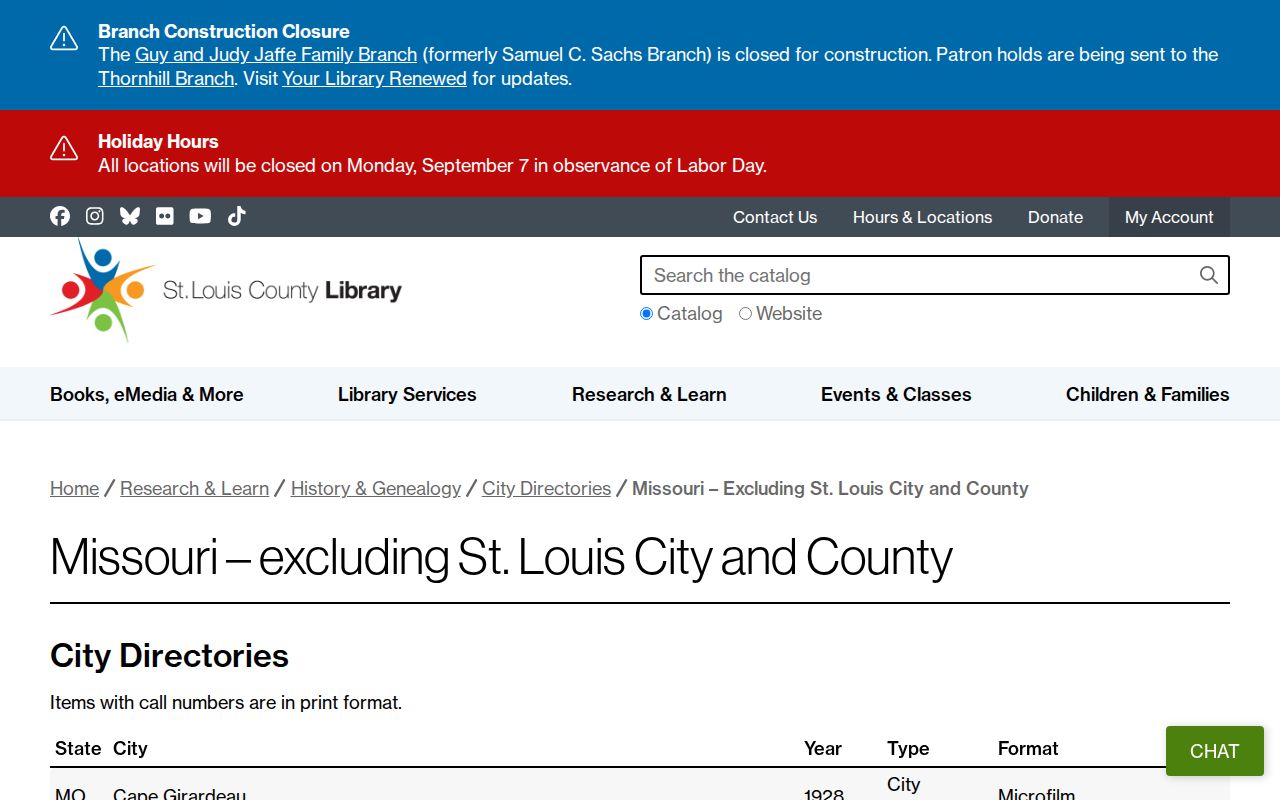
Its year-by-year presentation is useful for choosing the closest surviving volume on either side of a gap.
Joplin’s 1891 Directory
The earliest located Joplin volume is the 1891 printed reference, identified as R 977.872 B432J in the St. Louis County Library collection. It sits only one year before Blendville was annexed into Joplin. That local boundary change matters when a name or address seems to appear under a village, addition, township, or Joplin label in nearby sources. Preserve the form printed in the book before trying to normalize it to a current street or neighborhood name.
Directory coverage begins after the earliest Jasper County records. Jasper County was organized in 1841, and its courthouse was destroyed by fire in October 1863, although surviving volumes and later finding aids preserve parts of the county record trail. For a family that arrived before the first located directory, county deed indexes, probate material, cemetery records, newspapers, and census sources may supply the bridge. The directory is a strong starting point for a late nineteenth-century address, not a complete substitute for those sources.
Note: An old Joplin place name can describe a historic settlement or addition rather than the present municipal boundary.
Joplin Microfilm Directory Runs
The combined Joplin and Carthage sequence covers 1902 through 1907. Joplin-only microfilm then appears for 1909-1911, 1913-1914, 1920-1923, and 1925-1933. Later groups include 1937-1942 and 1946-1947, with individual or grouped listings for 1949, 1951, 1953, and 1955-1960. These intervals create a practical search pattern: use the closest earlier and later issue, then test the name and address in both directions.
Microfilm is also useful when a later printed directory is hard to locate. Bring the address, surname variants, and a short list of target years. Record the reel, year, page, and printed abbreviations along with the entry. That small record makes it possible to revisit a result and compare it with a census or a deed without relying on memory.
- Start with the closest available directory after a known address or event.
- Check the same surname and street in the closest earlier issue.
- Write down the page, year, spelling, initials, and every printed abbreviation.
- Test a nearby issue before deciding that the household moved or disappeared.
Polk’s Joplin Volumes
R. L. Polk & Company of Kansas City is confirmed for Joplin volumes dated 1932, 1939, 1946, 1956, and 1963 in an official historic-resources bibliography. The St. Louis County Library microfilm list also identifies several of the surrounding periods. Polk’s name helps identify the edition, but it does not remove the need to inspect the volume itself. The layout, abbreviations, name treatment, and possible street-order material can change between editions.
- 1891: the earliest located Joplin printed reference volume.
- 1902-1907: combined Joplin and Carthage directories on microfilm.
- 1909-1933: several Joplin microfilm runs, with documented gaps.
- 1932, 1939, 1946, 1956, 1963: Polk volumes confirmed in the historic-resources bibliography.
Use a Polk volume to distinguish people with the same surname by address and recorded occupation. A business listing or civic institution can add context, yet it should remain a lead for family or local-history research rather than a conclusion about identity. The strongest match pairs a name with an address and at least one independent historical source.
Reading Joplin Directory Entries
A directory entry should be read as a compact record, not as a modern profile. The name section usually organizes surnames first. An entry may add initials, a spouse or widow notation, a recorded occupation, an employer or business, and a street address. Some volumes may use householder or ownership-style marks, but the local key must be checked before a symbol is treated as evidence. A later telephone or reverse directory can add an address link, but it does not prove every member of a household.
| Name line | Surname-first form, given name or initials, and occasional honorifics. |
|---|---|
| Relationship notation | A spouse, widow reference, or other shorthand that must be read from the volume’s own key. |
| Occupation line | A recorded occupation, employer, business, or institutional connection that can separate same-name people. |
| Address | Street and number, sometimes with a rooming, hotel, or business context. |
| Listing marks | Possible householder or tenure-style notation only when the edition explains the mark. |
- Criss-cross directory
- A reverse section arranged by street and number, used to find a listed address before returning to the name section.
- Householder index
- An arrangement that emphasizes the person listed for a household or address, not every person who may have been present.
- Abbreviation key
- The explanatory list near the front of a volume. Photograph or transcribe it before interpreting short marks such as relationship or residence clues.
A Joplin scan was not available for a transcribed sample entry during research. Reading the original page and its front matter is the safe way to interpret a local abbreviation.
Joplin Library Directory Desk
Joplin Public Library’s Local History and Genealogy department is at 1901 East 20th Street. The library lists hours of 9-6 on Monday, Wednesday, and Friday; 9-8 Tuesday and Thursday; 9-5 Saturday; and 1-5 Sunday. Reference staff can help with directory years, microfilm, obituary searching, scans, and database access. The library catalog identifies city directories, a business directory, a cross-search reverse phone directory, Names and Numbers, and News-Herald microfilm.
Ancestry Library Edition is available on library computers, while HeritageQuest offers census images, family and local histories, tax lists, directories, and probate material. Digital Sanborn Maps covers Missouri maps from 1867 through 1970, with off-site help directed to Reference Staff at 417-624-5465. Sanborn sheets show buildings, lots, materials, alleys, and uses. They do not identify every person at an address.
The Joplin Public Library catalog browse shows the local directory and reverse-directory leads.
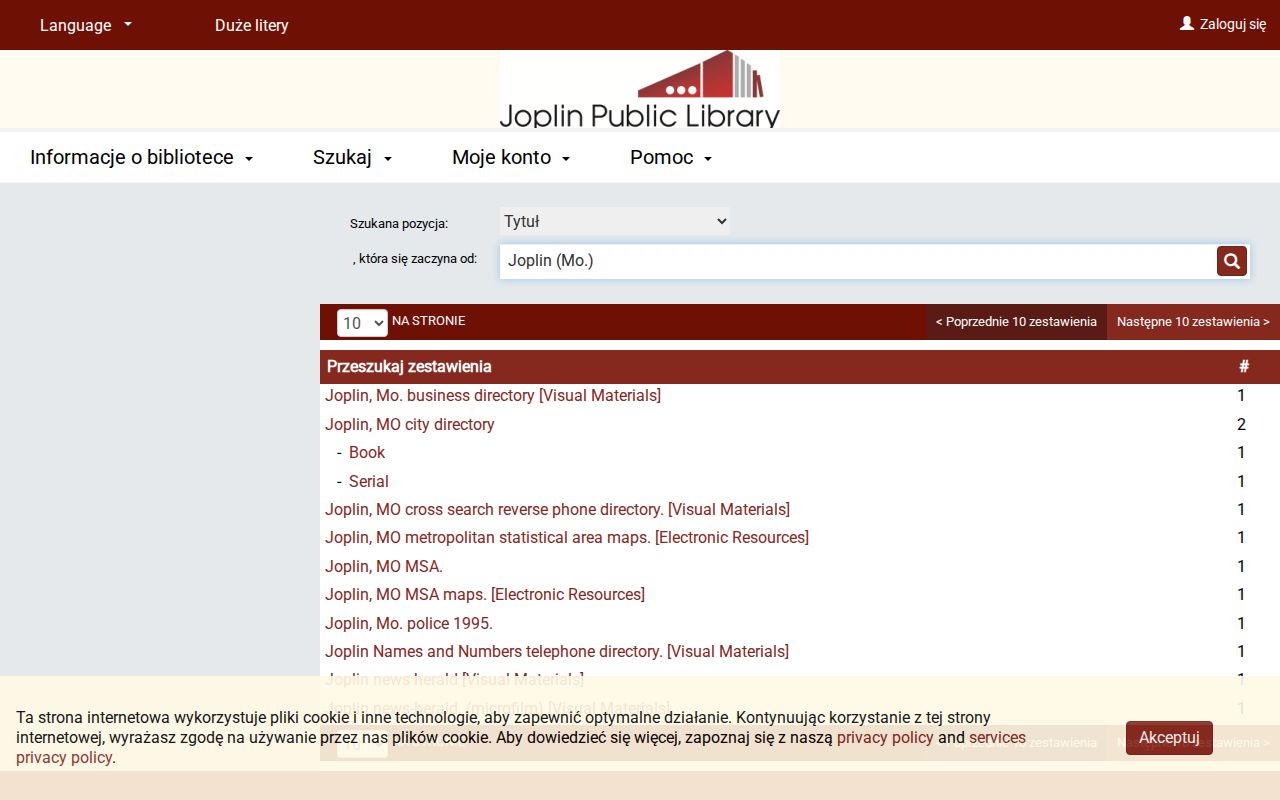
The catalog is best used as a starting list, then confirmed with Reference staff for a particular year and format.
Joplin Reverse Directory Searches
The Joplin catalog’s cross-search reverse phone directory is the historical address-to-listing route. Start with the number and street when tracing an old household, then return to the name section to compare initials, spouse notation, and recorded occupation. Because the catalog result did not expose a specific publication year, ask the desk for the volume’s date and arrangement before relying on it for a particular address.
Reverse and telephone material can be especially helpful after a directory entry gives a street but no obvious family connection. It is still a limited listing. A business, hotel, or rooming setting can appear in a telephone record, and one telephone listing does not establish a full household. Pair it with the available decennial census, a deed, a probate record, or an obituary when the question concerns family relationships.
Tracing Joplin Households by Year
Follow a household through directories one issue at a time. Begin with the address in a reverse or street section when possible, since a surname can be abbreviated or indexed under initials. Then pair the directory trail with the decennial census that falls near it. In 2026, 1950 is the latest public decennial census release under the 72-year rule. Census geography may not match a current Joplin boundary or ZIP, so save its exact locality and enumeration details.
- Find the first available listing for the address or surname and record the printed form.
- Check the nearest prior and next directory for a move, changed notation, or altered address.
- Use the name section to test initials and spelling variants.
- Pair the closest directory decade with a public census release and compare the address carefully.
- Use deeds, probate, obituaries, or permits to resolve a transition that the directories leave unclear.
A disappearance can mean a move, death, an unlisted household, or a gap in the collection. The Joplin past-residents search follows the address backward through deeds, maps, and other house-history sources when an older directory leaves that question open.
Note: Keep a year-by-year log so a missing issue is not mistaken for a missing person or household.
Joplin Directories and Endpoints
A directory clue often needs an endpoint. The Jasper County Records Center holds cemetery, court, genealogical, historic-newspaper, photograph, scrapbook, map, marriage, probate, real-estate, school, and tax materials, plus a reference library. It is at 125 Lincoln Street in Carthage, open Monday through Friday from 8 a.m. to 3 p.m. Staff may be able to provide out-of-area scans, while restricted material can remain closed because of confidentiality, condition, or donor terms.
For a death or family transition, the Joplin Globe obituary search can be checked against Fairview and other cemetery leads, probate metadata, and the directory record. Fairview’s state microfilm route includes early alphabetic records, 1911-1942 segments, and sexton reports through 1990, but the reels are not online. Parkway Cemetery, built by the WPA in the late 1920s for Joplin’s Black residents, and Osborne Memorial also add community-history context to a directory trail.
The Jasper County Records Center access page describes its historical holdings and research access.
The Center is a helpful finding-aid stop when an old directory points toward probate, deeds, cemetery material, or local newspapers.