
Joplin Previous Residents Sources
Joplin previous residents are best traced with an era check first. Deeds identify transfers of title. Directories, reverse directories, and census pages identify people listed at a place. Sanborn maps date a building or lot feature, while permits can help date a later change. Obituaries, probate records, and cemetery material help close a family or community trail. An owner’s mailing address is not proof that the owner lived at the parcel, so keep ownership and presence in separate columns of a research log.
| Source | Years It Covers | Where Held | What It Shows |
|---|---|---|---|
| Jasper deed books and indexes | Early records through 1969 in the archival route | Missouri State Archives, Records Center, and Recorder | Grantor, grantee, volume or page, legal description, and title transfer |
| Jasper Recorder route | 1970-present local-custodian threshold; web cutoff not published | Recorder counter and iCounty | Released recorded instruments and copy-request route |
| Joplin and Carthage directories | 1902-1907 | St. Louis County Library microfilm | Listed households, occupations, and addresses |
| Joplin directory runs | Selected runs from 1909 through 1963 | Library microfilm and Joplin library holdings | Address-linked people and business listings |
| Federal census | 1900-1950 currently public | Library databases and census resources | Household composition, age, birthplace, relationship, and tenure clues |
| Sanborn maps | 1867-1970 Missouri collection | Joplin Public Library database | Building footprint, lot, use, materials, and street context |
For a recent title question, start with the current parcel and recorder trail. For a household question in the first half of the twentieth century, start with the nearest available directory and census. When the address is much older than the house or street label, compare the legal description, plat, and map before drawing a conclusion.
Joplin Past Resident Starting Point
Use Jasper County Tax View to locate the current parcel on the Jasper side of Joplin. It accepts a parcel number, owner name, street number, street name, city, or ZIP and instructs visitors to search one field at a time. The parcel number, also called an APN, is the clearest starting key when available. Tax View warns that owner names may be indexed in different orders and that the mailing address may differ from the physical property address.
Save the situs address, APN, legal description, addition, lot, block, and current owner from the parcel material. The legal description is especially important for prior residents because old deeds may never use a modern street number. If the Joplin address lies on the Newton County side, route the parcel and recorder research to the appropriate Newton County office instead of assuming Jasper County holds the land record.
Myth: A current owner name or tax mailing address does not establish who lives at a Joplin property. It is a lead for the title trail.
Note: Keep the APN and legal description beside the street address because they stay useful when labels and boundaries change.
Joplin Deed Chain for Past Residents
The Jasper Recorder of Deeds is the ownership anchor for the Jasper side of Joplin. Its public route directs users to iCounty, where the index can be reached with the stated guest path. The recorder says online records are released only after recording, indexing, verification, and release, and it warns that the online version is not the official public record. Document images require a subscription or a request to the office. The public search page also has a PayPal copy route that requires the book and page details.
- Use the current parcel record to capture the legal description and current owner.
- Search the current owner as the grantee, meaning buyer, for the likely acquisition deed.
- Read that deed for the grantor, meaning seller, along with the book, page, document number, and legal description.
- Search that seller as a prior grantee and repeat the process one transfer at a time.
- Compare lot, block, addition, and metes-and-bounds wording at each link before treating it as the same property.
- Grantor and grantee
- The grantor transfers an interest. The grantee receives it. A backward search commonly moves from a later seller to the earlier deed where that person was buyer.
- Chain of title
- The sequence of recorded transfers that links one owner to the next. It is an ownership trail, not a list of every occupant.
- Legal description
- The lot, block, addition, township, range, or metes-and-bounds wording that identifies land more reliably than an old street number.
The Jasper Recorder real-estate page explains the office’s land-record and plat context.
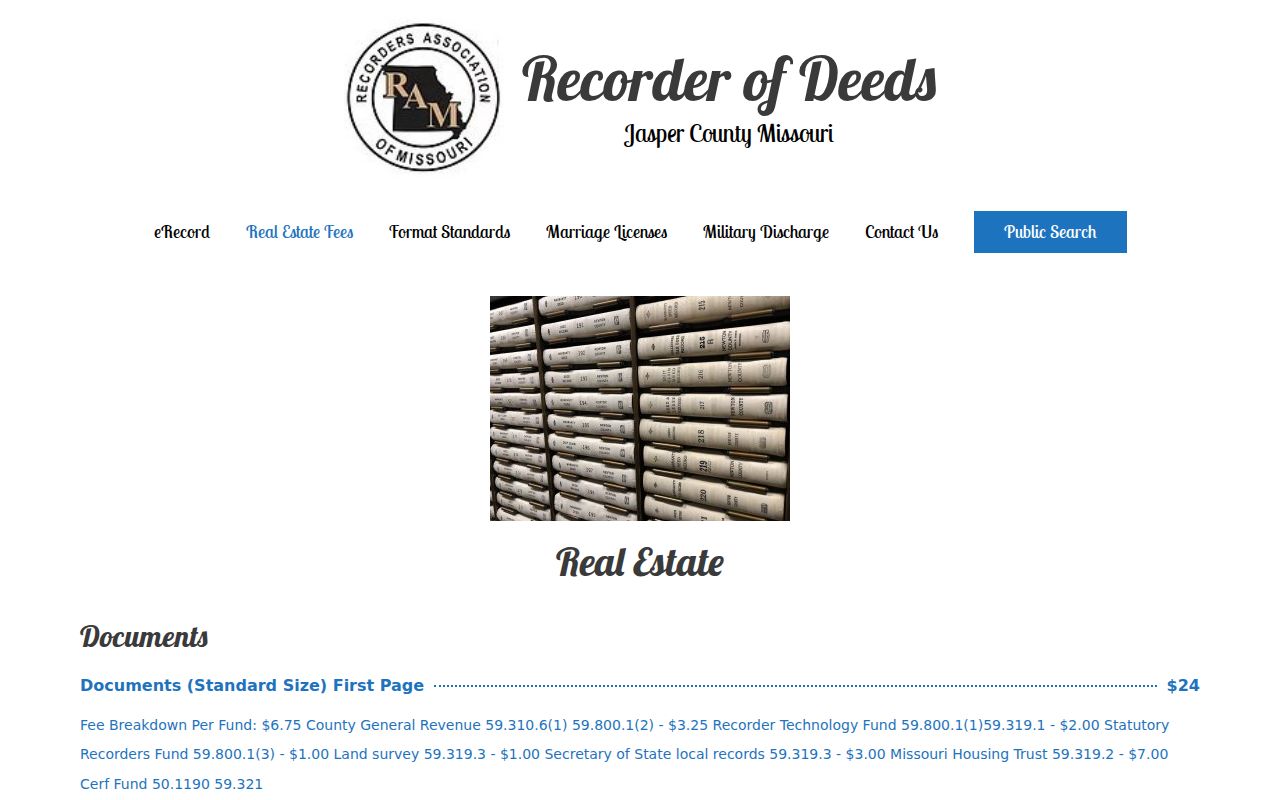
The Recorder’s materials support a book-and-page approach when an old Joplin address is not visible in a deed index.
Joplin Records at 1969-1970
The most important local divide is not a claimed web cutoff. The official sources did not state the first or earliest online iCounty year. The Missouri State Archives Jasper County guide instead directs records dated on or after January 1, 1970 to the local Recorder, while older county deed books and indexes are documented in the archival microfilm route. A Joplin previous-residents trail that crosses 1969 and 1970 should plan for both channels.
For early material, the Archives guide describes direct grantor indexes and indirect grantee indexes with volume and page references. Jasper County Records Center is another local historical research stop, but it may be a finding aid rather than the office holding the original. Call or submit a request before traveling, especially when a specific book, reel, or image is needed. Do not assume that a blank online search means the deed or index does not exist.
Joplin Past Resident Plat Trails
Lot and block language points to a different search than a street name. Jasper Recorder guidance describes a town-lot index and plat index that can be used with addition or subdivision names. A deed may use a phrase such as a lot and block in an addition, or it may rely on section, township, range, and metes-and-bounds. Copy those words exactly, including dimensions and adjacent references, because they tie an old record to a parcel even when the current address has changed.
Joplin’s mining-era growth complicates address continuity. Blendville was annexed in 1892, and numerous subdivisions were annexed during the twenty years ending in 1910. A historic person may therefore be associated with a village, addition, township, or county pocket before a source uses the present Joplin label. No official citywide street-renumbering crosswalk was located, so preserve the source language and compare plats, Sanborn maps, directories, and historic-preservation material.
Joplin Past Resident Directories
Deeds identify title holders. Directories answer a separate question: who was listed at the address. Joplin and Carthage directories survive on microfilm for 1902-1907, with Joplin runs for 1909-1911, 1913-1914, 1920-1923, 1925-1933, 1937-1942, and 1946-1947. Polk volumes are confirmed for 1932, 1939, 1946, 1956, and 1963. The Joplin Public Library catalog also identifies a cross-search reverse phone directory, which is the address-to-listing path when its date is confirmed at the desk.
Read the name, number, street, relationship notation, and printed abbreviations together. A directory listing can be a household head, a rooming or hotel listing, or a business contact. It does not prove every person present at an address. The Joplin city-directory collections detail the known runs, shelf channels, and how to interpret a volume’s own shorthand.
Note: Match each historical address to the directory’s year before comparing it with a later property or census record.
Joplin Sanborn House Dates
Joplin Public Library’s online resources include Digital Sanborn Maps for Missouri from 1867 through 1970. Start with a current street or intersection, then compare the same block across available nineteenth-century, early twentieth-century, and later sheets. Record lot lines, building footprint, porch or wing, outbuilding, alley, material, use, and street number. Off-site help is directed to Reference Staff at 417-624-5465.
A map can show when a structure was present or altered. It cannot automatically name the people who lived there. Pair a Sanborn observation with a directory, deed, census, permit, or newspaper source. Joplin Building Division’s Click2Gov portal provides public permit-status viewing for later address history, but its inspected public material did not state an exact coverage start date or public field list.
Joplin Previous Household Trail
Pair the address trail with the public census release nearest the directory year. The census can contribute household members, relationships, ages, birthplaces, and recorded tenure, while a directory may supply a more frequent address clue between census years. Start from a directory address, check a nearby census year, then use deeds and maps to make sure the location is the same. Census locality and boundaries can differ from a current Joplin ZIP or city line.
- Record the address exactly as it appears in the closest directory year.
- Find the nearest public census release and preserve its locality, page, and household detail.
- Compare the directory address with the parcel description, map, or plat before treating the locations as identical.
- Use a deed, obituary, probate entry, or cemetery source only to resolve a specific transition.
To close the trail, search the Joplin Globe obituary index by first name, last name, date, and city. An obituary can point to relatives, a former address, funeral home, or cemetery, but it is family-supplied context rather than a legal title record. Jasper Probate Division and Missouri Case.net can supply public estate metadata where available; protected or sealed material stays unavailable.
The City of Joplin Fairview Cemetery history provides the source context for a community endpoint.
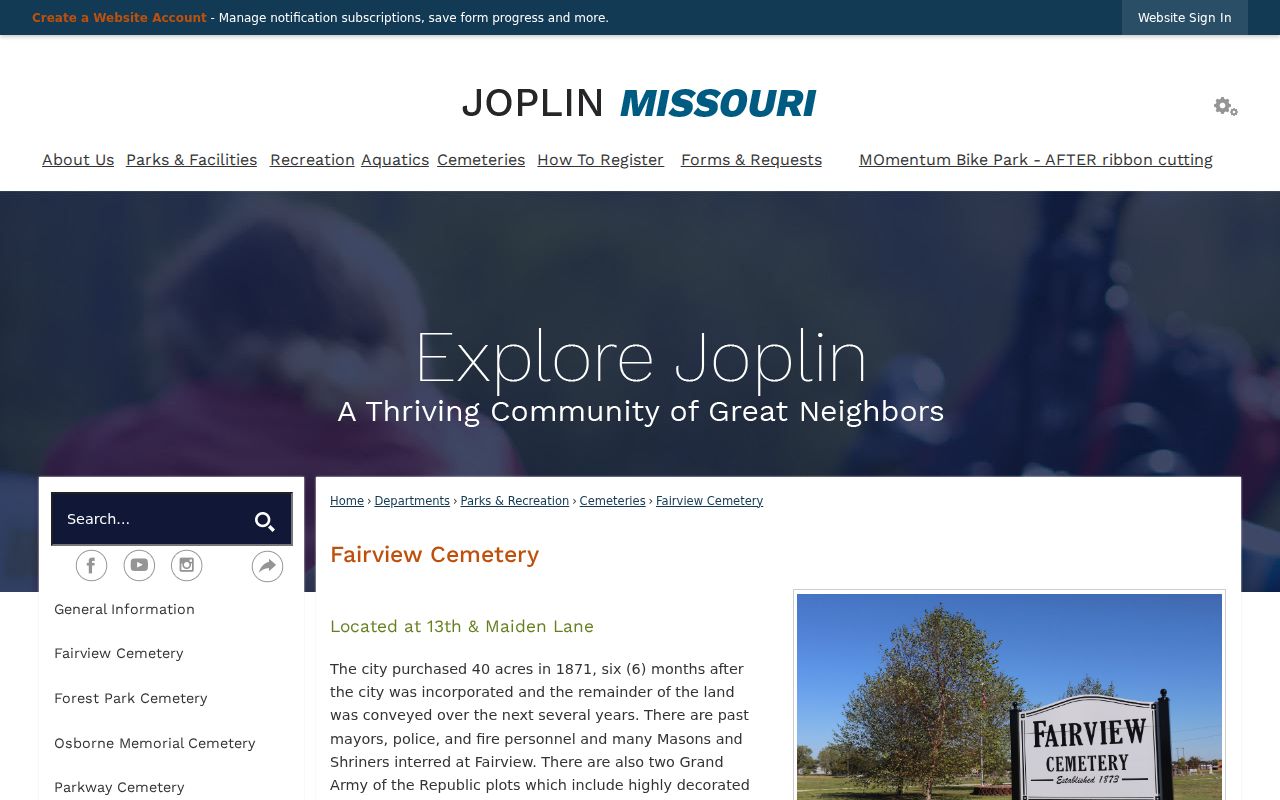
Fairview records and state microfilm can help distinguish a death or burial lead from the ownership history of the parcel.
Joplin Past Resident Limits
Public records do not supply a complete list of everyone who has lived at an address. Some people are absent from deeds, directories, or public filings. Utility customer information and driver-license addresses are not public resident sources. Missouri Safe at Home participants use a substitute address in new government records, and protected voter, court, vital, juvenile, adoption, and sealed material has separate limits. Treat an absent record as an unanswered question, not proof of absence.
Use past-resident research for house history, family history, estate questions, and local curiosity. Keep every result in context and do not use a historical address trail to harass, threaten, follow, or repeatedly contact a living person. Missouri’s stalking statute, RSMo 565.225, makes purposeful harassment and following unlawful.